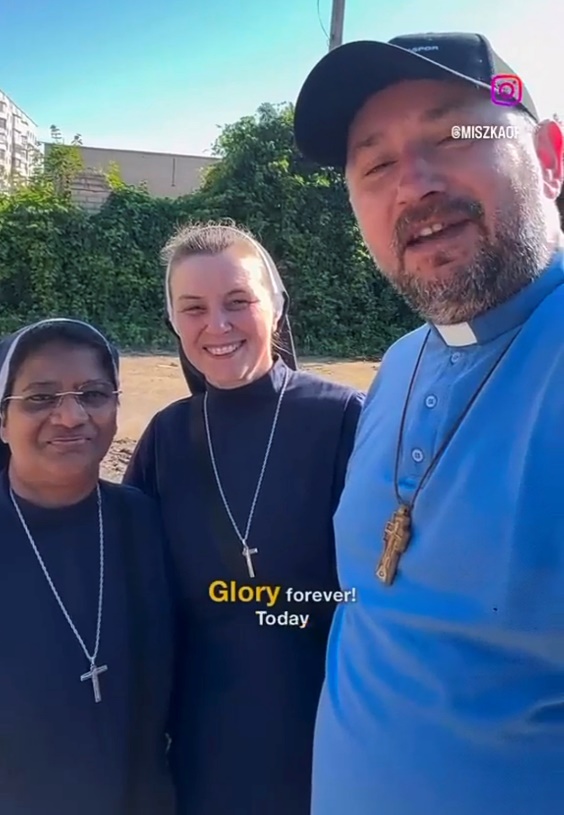
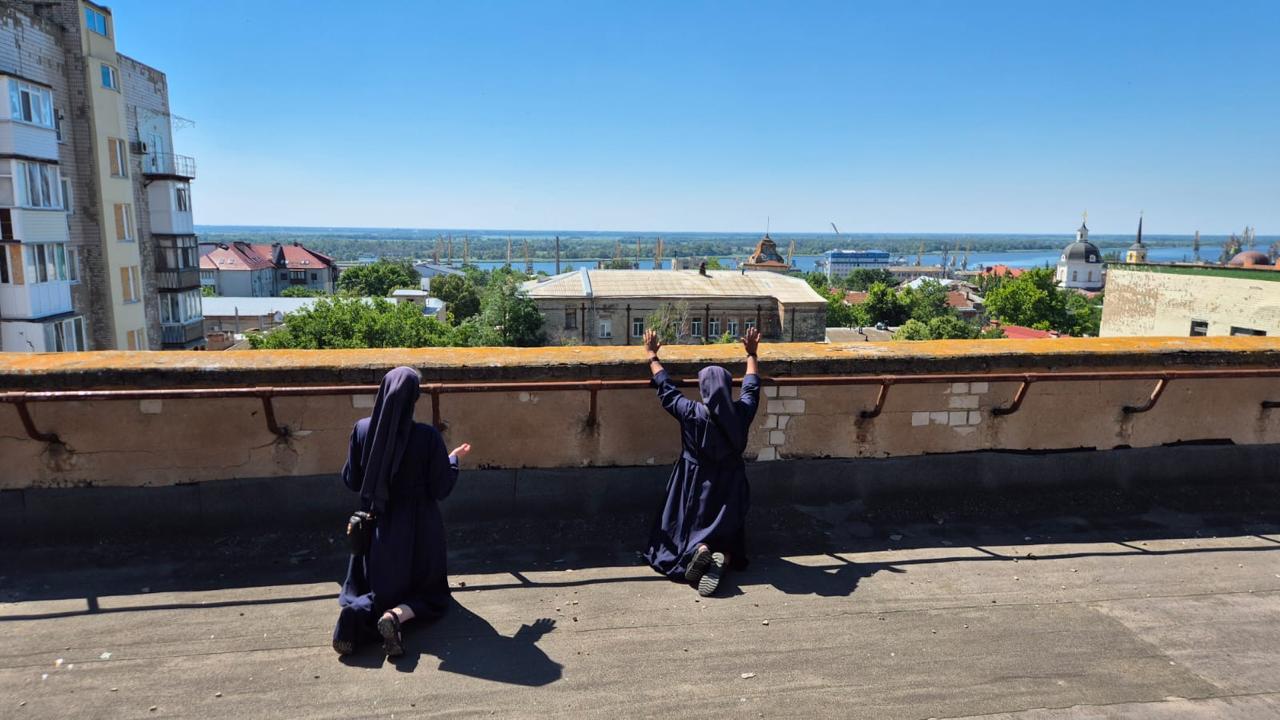


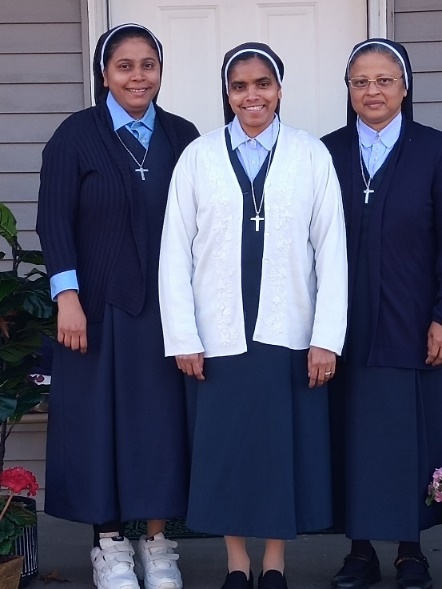
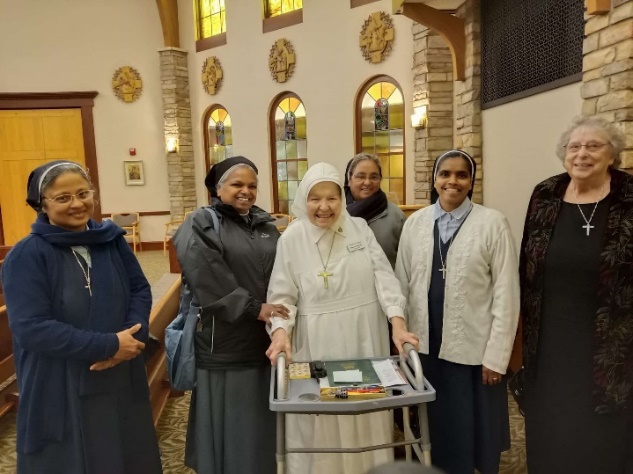
There are journeys after which a person can never look at the world the same way again. Such was the trip of Sister Ligy and Sister Laura through central, eastern, and southern Ukraine — Kyiv, Kharkiv, Zaporizhzhia, and Kherson. They did not go as observers, but as witnesses — to see, to hear, to stand beside people for whom war has long stopped being news and become a daily way of surviving.
The Zero Line
The sisters were at what are called "zero positions" — places as close to the frontline as it is possible to be, where the distance between life and death is measured not in kilometers but in seconds. There are no pauses between air raid alarms: shelling struck every hour, and every hour became a trial — not only physical, but above all spiritual. Living at such a place, where danger leaves no room for rest even at night, is an experience that cannot be fully conveyed in words to those who have not lived through it.
Kherson: A City on the Edge
The impression left by Kherson was especially heavy. Nearly every building in the city has been destroyed — the war has left its mark on every street. Part of the city is still under occupation, and even the liberated part has found no peace: there is no water. The cause is a tragedy that shocked the whole world: the destruction of the dam, after which many people died, and bodies still remain in the water. Because of this, the city's water supply is unusable — water has become a source not of life, but of danger.
This is one of the most painful paradoxes of war: liberation does not always mean a return to normal life. People regain freedom of movement but lose the most basic things — clean water, safe housing, the sense that tomorrow will resemble today.
The situation in the occupied part of the city is a separate, even deeper wound. The people who remain there are living through something that, in the 21st century, seems as though it would not be possible: the occupying authorities do not allow humanitarian aid to reach residents, and Russia itself provides none either. To survive, people are eating rats. For five years now, they have had neither electricity nor water — conditions we take for granted as basic have become an unattainable luxury there.
Those Who Survived Captivity
The sisters spoke with women and men who had survived captivity. Such conversations demand particular gentleness and patience — the trauma of captivity stays in the body and memory for a long time, and every account costs the person telling it dearly. That these people found the courage to speak is, in itself, an act of bravery.
Humiliation as a Weapon
One of the men the sisters spoke with shared a story that reveals another dimension of this war — the use of humiliation as a tool of pressure. He recounted that Russian soldiers stopped the bus he was driving and forced every passenger to speak only Russian. Then everyone was taken outside and forced to strip naked in the street.
This is not simply an act of cruelty — it is testimony to how occupation tries to break a person not only physically but from within, stripping away the most fundamental things: the right to one's own language, one's own body, one's own dignity.
The Woman Who Carried Her Life in Her Hands
Among the stories that left the deepest mark on the sisters is that of a woman who looks about ninety years old, though she is in fact fifty-seven. The gap between her outward appearance and her biological age is silent testimony to what the war has done to her. She suffered a lacerating wound from a missile explosion and, holding her own abdominal organs in her hands, walked to a doctor on her own.
It is hard to find words adequate to such an experience. This is a story not only of physical suffering, but of a will strong enough to keep a body moving even when moving seems impossible.
Children Given Back the Chance to Learn
Among the people the sisters met is a family with two children, eleven and thirteen years old, who have serious injuries. In the place where they currently live, schooling is impossible: there is neither safety nor the conditions for it. Hearing this story, we all decided together to give these children an opportunity, and we invited the family to move to us — to give them what they deserve: the chance to learn, to grow, to have something resembling a childhood after all they have endured.
This decision is not simply an act of mercy. It is a recognition that a child's education and future should not depend on where exactly the front line happens to fall.
A City Where Every Step Matters
One of the most telling details of this journey is a warning the sisters heard and carried with them from their own experience: in the city, one must walk very carefully, because mines are hidden everywhere. ‘Said matter-of-fact’, this sentence in fact describes a completely transformed reality: a space that was once an ordinary city of sidewalks, courtyards, and parks now demands constant vigilance. Even an ordinary walk becomes a decision requiring a calculation of risk.
What to Do With What Was Seen
Coming home did not put a period on this story — on the contrary, it has become its continuation. Having seen with their own eyes how people live practically at zero, Sister Ligy and Sister Laura — and, together with them, all of us who prayed and waited for their return — understood that simply telling what they had seen was not enough.
So a decision was made: to direct all our shared efforts toward bringing in donors to help build homes for families who still live practically on the frontline and have no way to move to safer territory — to us. These are people who, for various reasons, cannot leave: some have nowhere to go, others have nothing to go with, still others are simply so exhausted that they no longer have the strength for another move into the unknown.
We recognize that we, too, sometimes live through shelling, and that this leaves its own mark. But comparing our experience to what is happening at zero, in a ruined Kherson, or in the places from which people emerge from captivity, is impossible. The difference is too great to consider our trials equivalent. That is exactly why our duty is not to stay silent about what we have seen, but to act: to seek out donors, to build homes, to give families a real chance to move to a place where shelling every hour is not part of daily life.
Every home built is not just a roof overhead. It is the chance for a child to go back to school, for parents to stop counting the minutes between air raid alarms, for a family to begin living, rather than merely surviving.
The account of Sister Ligy and Sister Laura is not simply a description of ruined buildings or a tally of shelling. It is testimony about people: about a woman who walked to a doctor holding her own life in her hands; about children held back a chance to learn; about the residents of Kherson living without water among the ruins; about those who returned from captivity and found the courage to speak; about a man who was forced to strip naked in the street simply for wanting to speak his own language.
Journeys like this are a reminder: behind every piece of news about the war stand real faces, real names, real fates. And often the most we can do is to see, to listen, not to look away — and to turn what we have heard into concrete action that gives families a roof overhead and the chance to keep living.
With love and prayer,
Sister Kristina and the sisters from Ukraine
.jpg)
 (1).jpg)
.jpeg)
.jpeg)
.jpeg)
.jpeg)

.jpeg)
.jpeg)
.jpeg)
.jpeg)
.jpeg)

.jpeg)
.jpeg)
.jpeg)

.jpeg)
.jpeg)
.jpeg)

.jpeg)
.jpeg)
.jpeg)
.jpeg)
.jpeg)

.jpeg)
.jpeg)
.jpeg)
